

Oklahoma
Interfaith Dialogue Event
APRIL 2026 | IN-SESSION REPORT

Your Thoughts Made Visible
Powered by the Dialogue Reflection System™
What you are about to see is a live reflection of a real conversation (YOUR conversations), processed in real time.
Using the Dialogue Reflection System™, we analyze the language, tone, and patterns within the discussion to surface emerging themes, shared insights, and symbolic representations of what is being built together.
This is not a summary. It is a reflection, designed to help you see your own conversation more clearly as it unfolds.
Emerging Themes:
As participants shared their perspectives, several patterns began to surface across tables. These themes reflect what is gaining clarity in the room, not as conclusions, but as shared directions of thought and understanding.
Freedom Expands When We Consider Others
Across both the dialogue and written reflections, participants repeatedly moved beyond individual definitions of freedom toward a shared recognition that freedom cannot exist in isolation. Words like empathy, listening, respect, and “considering other people” surfaced consistently. There is a growing awareness that personal freedom, when disconnected from others, becomes limiting or even harmful. What is emerging is a reframing: freedom is not just something we have, but something we must hold in relationship with others.
Self-Awareness is the Starting Point for Responsible Freedom
Participants consistently named the need to examine their own biases, assumptions, and emotional responses before engaging others. Phrases like “separate self,” “identify bias,” and “use emotional intelligence” point to a deeper realization that the work of freedom begins internally. Rather than focusing first on changing others or systems, many participants are recognizing that responsible freedom requires self-regulation, humility, and awareness of how their own perspectives shape their actions.
Freedom is Defined Through Relationship, Not Isolation
Participants are moving beyond seeing freedom as an individual right and beginning to define it in relation to others. Language around dignity, respect, and “my freedom ends where yours begins” reflects a growing recognition that freedom is not something we hold alone. It is shaped, limited, and strengthened through how we treat one another. What is emerging is a relational understanding of freedom, where care, not just choice, becomes central.
Surprising Discoveries
Alongside these themes, a few unexpected insights emerged. These discoveries highlight moments where the conversation moved beyond what might typically be assumed, revealing deeper shifts in how participants are thinking about freedom and responsibility.
People Recognize Their Own Limits More Readily Than Expected
Rather than doubling down on positions, many participants openly acknowledged a natural tendency to limit others’ freedom based on their own comfort, values, or preferences. Statements like “we want freedom for others as long as it aligns with our preferences” and reflections on selfishness and bias show an unexpected level of self-honesty. This suggests that when given the right conditions, people are more willing to confront their own contradictions than to defend them.
Hope Emerges as a Discipline, Not Just a Feeling
Amid discussions of fear, polarization, and division, participants did not default into despair. Instead, they articulated hope as something that must be actively maintained. The idea that “we have a responsibility not to lose hope” reframes hope from a passive emotion into a deliberate choice. This is significant because it positions hope as a form of civic responsibility, not just personal outlook, aligning with the broader aim of sustaining freedom through intentional action.
Moral Language is Re-entering the Conversation Without Division
Rather than avoiding values or belief-based language, participants are bringing in concepts like love, faith, and dignity in a way that does not divide the room, but deepens it. This is notable because these types of references often polarize, yet here they are being used to expand understanding and reinforce shared humanity. It suggests that when the environment is right, deeply held values can unify rather than separate.
THE MULTARITIES OF
Carrying Freedom Forward With Care
This visual maps the tensions that shape how freedom is understood and carried forward. Each spoke represents a pair of forces that often pull in different directions, yet both are necessary. These are not problems to solve or sides to choose. They are realities to navigate.
At any given moment, we may lean toward one side or the other. The work is to recognize that movement, and to engage each tension with greater awareness and intention. When we do, these competing forces begin to work together, strengthening rather than weakening the way we live, relate, and act.
This is what it means to carry freedom forward with care.
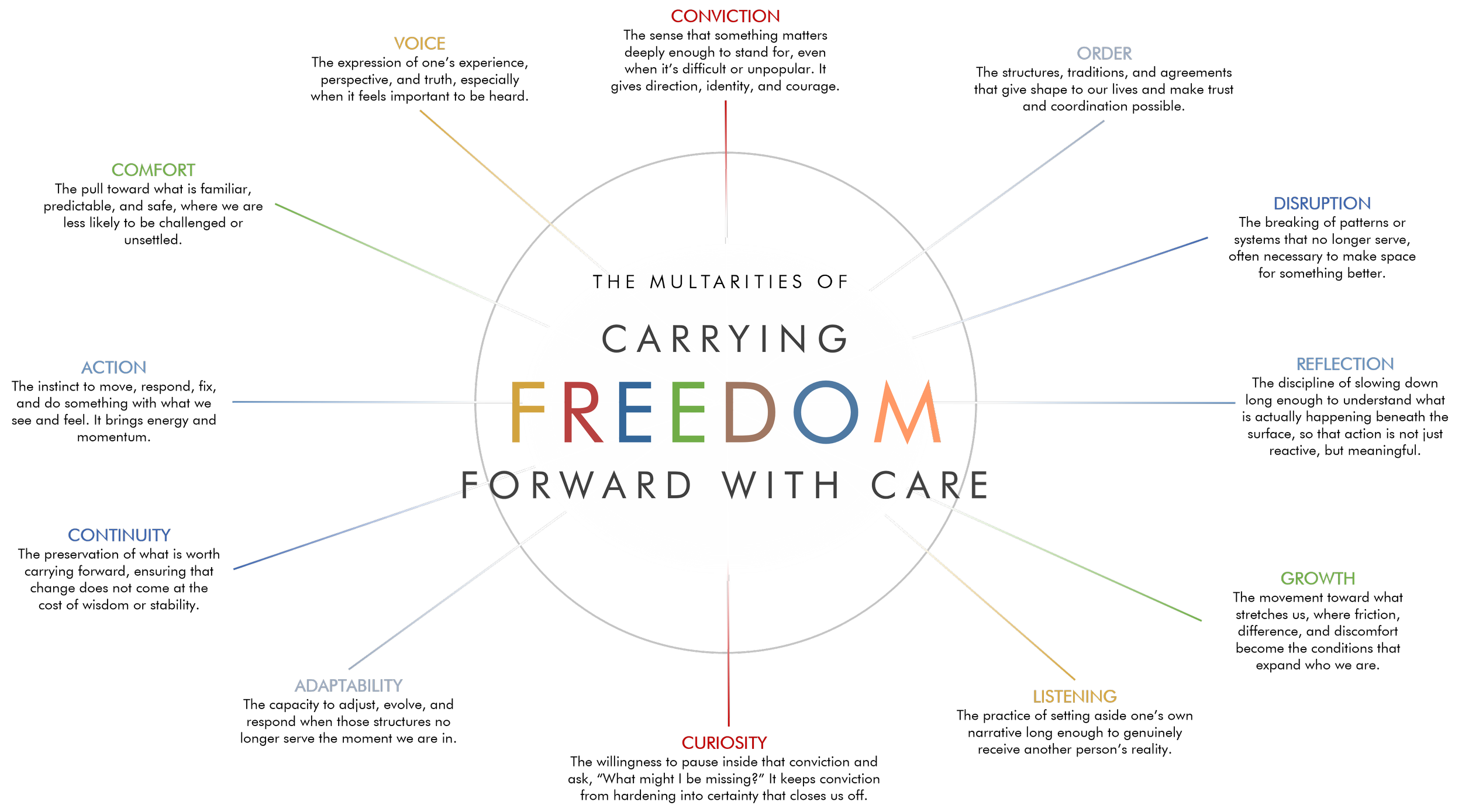
The conversation revealed a series of tensions around how people hold their beliefs while living alongside others who see the world differently. Participants moved between commitment to their values and a desire for connection, between ideals of equality and the realities they experience, and between the comfort of certainty and the challenge of staying open.
At its core, the multarities reflect an ongoing effort to understand how freedom is lived out in relationship, recognizing that it requires both personal responsibility and a willingness to engage across difference.
The central question …
How do we carry freedom forward with care?
Holding Multiple Truths at Once
Carrying freedom forward with care requires more than agreement. It asks us to hold competing truths at the same time. These tensions are not problems to solve, but realities to navigate. When we learn to manage them well, they become the conditions through which freedom is sustained, not just claimed.
What this table shows is that freedom is not a single idea to defend, but a set of tensions we are already navigating. Each pole reflects real forces shaping how we think, relate, and act. When we lean too far to one side, our perspective narrows. When we can hold both with intention, our capacity expands.
Carrying freedom forward with care does not mean resolving these tensions. It means seeing them clearly and moving within them with awareness. This is where dialogue matters. It allows us to stay in the tension long enough to understand, adjust, and act more responsibly.
This framework is not separate from your experience. It reflects it. The question is not whether these tensions exist, but how you will engage them.
What symbols within the artwork speak to you, and what stories do you think they're trying to tell?
In what ways do the visual symbols challenge or expand your current perspectives on belonging?
How do the contradictions and paradoxes illustrated in the art resonate with your understanding or experience with the conversations around liberty and belonging?
A CLOSER LOOK AT SYMBOLOGY
Rooted, Yet Responsive
Continuity vs Adaptability / Order vs Disruption
To carry freedom forward with care requires both stability and responsiveness. Like a tree, freedom must be rooted in something deeper than the moment. It draws strength from shared values, lived experience, and the often unseen contributions of others. At the same time, it must remain responsive to changing conditions, willing to bend, adjust, and evolve without breaking.
What sustains it is not visible at first glance. Beneath the surface, it is supported by the steady work of people who choose to hold it up through their actions, their restraint, and their willingness to stay engaged. Without those roots, freedom becomes fragile. Without responsiveness, it becomes rigid.
To carry it forward is to recognize both. To remain grounded enough to preserve what matters, and open enough to respond to what is needed now.
Built From Both Sides
Voice vs Listening / Individuality vs Belonging
Self-Awareness vs Shared Responsibility
This image captures two parts of the same work. On one side, a person turns inward, beginning to recognize the thoughts, assumptions, and experiences that shape how they see the world. On the other, people move outward together, building something that does not yet fully exist. The connection between the two is not accidental. The quality of what we build together is directly shaped by the clarity with which we see ourselves.
Carrying freedom forward with care requires both. It asks us to become more aware of our own lens while also stepping into shared responsibility with others. Without self-awareness, what we build reflects our blind spots. Without shared effort, what we understand never becomes real. The work is to hold both at the same time, to see more clearly, and then to build differently because of it.
This is how freedom moves from idea to lived experience, not through certainty or agreement, but through people willing to examine themselves and then participate in something larger than themselves
Carrying freedom forward with care requires more than expressing our own perspective. It requires a willingness to move toward one another, even when we begin from different places. Each side of the bridge represents a voice, a set of experiences, and a way of seeing the world. Those perspectives are real and necessary, but on their own, they remain incomplete.
What sustains freedom is the work done in the space between. It is built when people are willing to extend beyond their own position, to listen as intentionally as they speak, and to take responsibility for connection, not just expression. The bridge does not form because one side reaches farther or speaks louder. It forms because both sides choose to move, to build, and to meet.
To carry freedom forward is to participate in that work. It is to recognize that difference is not the obstacle, but the material. And that what we build together depends on our willingness to meet within it, with care.
Seeing and Building at the Same Time
What’s Next
In the coming days, you’ll receive a link to a deeper reflection of today’s conversation. Thank you for showing up, sharing your perspective, and contributing to something larger than any one voice.
