

OK Justice Circle
Dialogue Analysis/Report
APRIL 2026 | COMMUNITY SESSION
OK Justice Circle
A Multarity Dialogue Analysis/Report
What happens when a group of people come together to explore what freedom asks of them now?
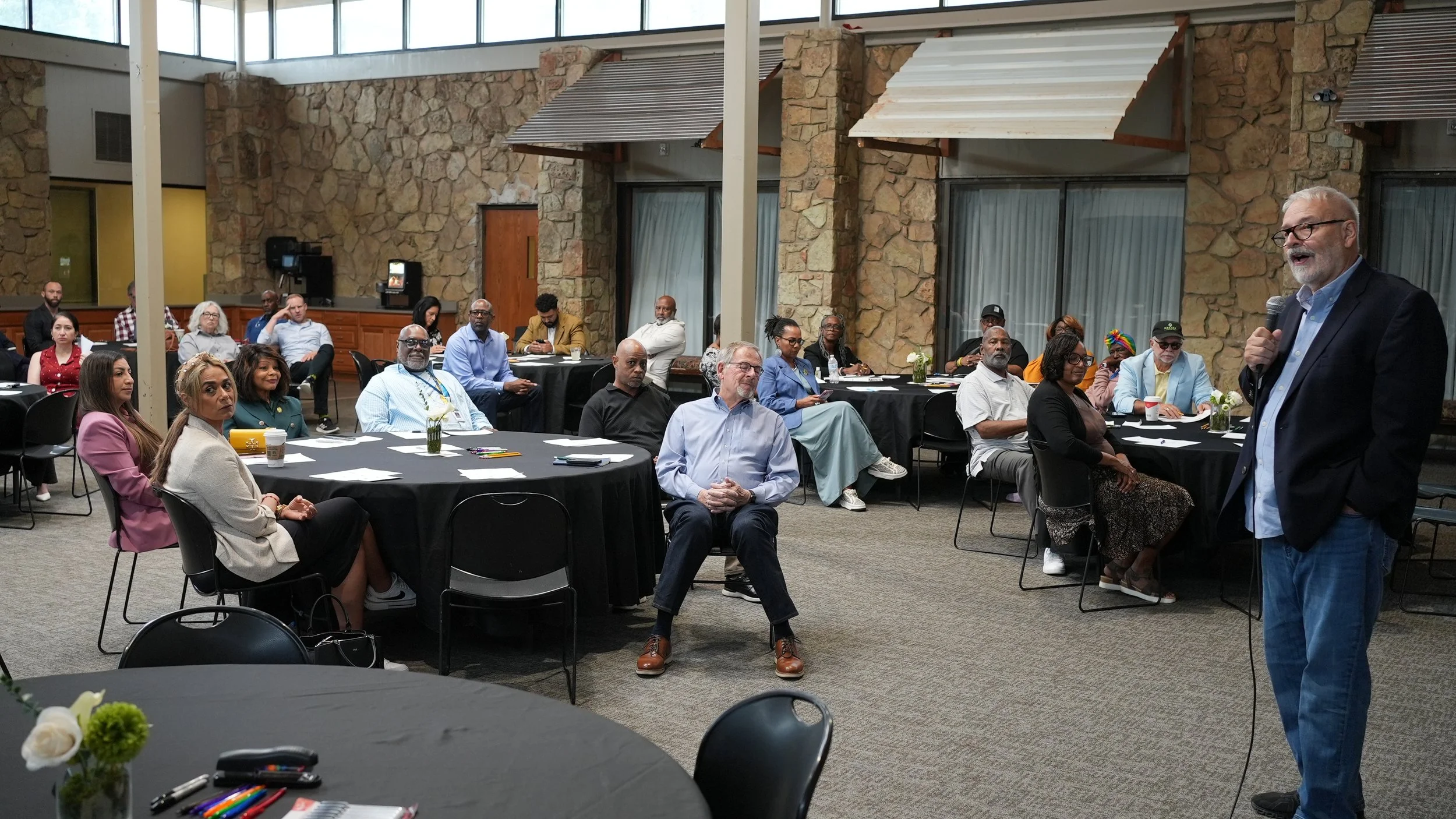
In this session with the Oklahoma Justice Circle, participants gathered around a central question: what does it mean to carry freedom forward with care? What emerged was not a single definition, but a layered exploration of responsibility, tension, and lived experience.
Across tables, participants spoke about freedom as something more than a right to be exercised. It was described as something to be held, protected, and extended, often in ways that require personal sacrifice, awareness, and restraint. Many recognized that freedom is shaped by different starting points, influenced by culture, history, and individual experience, and that it cannot be understood or applied uniformly.
The word care became a grounding force in the conversation. It introduced a dimension that slowed participants down, prompting them to consider how their actions, beliefs, and expressions of freedom affect others. This shifted the conversation from expression toward responsibility, and from individual perspective toward shared experience.
At the same time, participants openly named tensions. Differences in belief, fear, political division, and competing interpretations of truth surfaced as real challenges. Rather than avoiding these tensions, the group began to acknowledge them as part of the work itself, something to be recognized and navigated rather than resolved.
As the conversation progressed, attention turned inward. Participants reflected on bias, self-protection, and the need for emotional awareness. Many identified listening, curiosity, and the willingness to question one’s own assumptions as essential practices. The conversation began to move from what freedom is to what it requires of each person.
By the end of the session, a shift had begun to take shape. Freedom was no longer described only as something to defend or preserve, but as something that must be carried with intention, shaped by how individuals relate to one another, and sustained through ongoing reflection, dialogue, and action.
Invitation for Further Exploration
The conversation doesn’t end here.
What began in this room was not a conclusion, but the start of a deeper process, one that continues in the conversations you have, the questions you carry, and the choices you make moving forward.
If something from today stayed with you, follow it. Bring it into another conversation. Ask the question again. Listen a little longer. Consider what it means not just to hold freedom, but to carry it with care.
As you continue the conversation, you might explore:
Where do my beliefs about freedom make it easier, or harder, to extend it to others?
When does my sense of freedom come into tension with someone else’s, and how do I respond in that moment?
What assumptions or biases might I need to recognize before I can engage others more openly?
What does it look like to listen with the intention to understand, not to respond?
Where might I need to give something up in order to create more space for others?
How can I carry this conversation into another setting, with people who were not in the room?
Key Themes:
As participants shared their perspectives, several patterns began to surface across tables. These themes reflect what is gaining clarity in the room, not as conclusions, but as shared directions of thought and understanding.
Freedom Carries Responsibility, Not Just Rights
Across nearly every table, participants moved beyond defining freedom as something to possess and began describing it as something to carry. This shift introduced language around responsibility, sacrifice, and stewardship. Freedom was no longer framed as an individual entitlement, but as something shaped by how it is used, especially in relation to others, including those who may not experience it in the same way.
Care Changes How Freedom is Expressed
The addition of the word care consistently slowed and grounded the conversation. Participants described how freedom, when exercised without consideration, can become harmful or limiting. Care introduced a filter, prompting people to think about who is affected, when to speak, and how their actions land. This created a more deliberate and relational understanding of freedom.
Freedom is Experienced Unevenly
Participants repeatedly acknowledged that freedom is not experienced equally. Differences in background, culture, race, and personal history shape how freedom is understood and lived. This recognition created a shift away from one-size-fits-all thinking toward a more nuanced awareness that carrying freedom forward requires understanding different starting points.
Personal Bias is a Central Barrier
There was a strong and recurring emphasis on bias, both individual and generational. Participants recognized that assumptions, learned perspectives, and unconscious judgments shape how they interpret others and define freedom itself. The conversation began to turn inward, with an emerging understanding that self-awareness is not optional, but essential.
Tension is Inherent and Must Be Held
Rather than avoiding difficulty, participants began to name the tensions directly. Differences in belief, fear, politics, and competing interpretations of truth were all identified as real and persistent challenges. There was a growing recognition that these tensions are not problems to eliminate, but realities to navigate if freedom is to be carried forward with care.
Listening is the Primary Practice
Across responses, listening surfaced as one of the most actionable and immediate responsibilities. Not passive listening, but active, curious, and intentional listening. Participants described the need to understand before responding, to ask better questions, and to remain open even when disagreement is present. Listening became a practical way to engage the complexity of freedom.
Moving Forward Requires Letting Something Go
A quieter but important theme emerged around the idea of release. Participants reflected on the need to set down certain habits, assumptions, or emotional responses in order to engage more effectively. Whether described as bias, self-protection, or the need to be right, there was a growing awareness that carrying freedom forward may require letting go of something first.
These themes were surfaced through the Dialogue Reflection System™ (DRS), which aggregates and analyzes participant language across tables to identify recurring patterns, tensions, and areas of convergence.
Surprising Discoveries:
Alongside these themes, several unexpected insights emerged. These discoveries reflect moments where participants moved beyond familiar positions and began to confront deeper tensions within themselves and the idea of freedom itself.
Participants Acknowledged Their Own Limits More Readily Than Expected
Rather than defending their positions, many participants openly recognized a tendency to support freedom for others only when it aligns with their own values or comfort. This admission surfaced without resistance, suggesting a level of self-awareness that is often difficult to access in group settings. The realization that personal preference can act as a limiting force on freedom marked a subtle but important shift from external critique to internal examination.
The Group Recognized That Freedom Requires Tradeoffs
An unexpected but significant insight emerged around the idea that carrying freedom forward may require giving something up. Several participants articulated a willingness to limit or subordinate aspects of their own freedom in order to create space for others. This introduces a more mature understanding of freedom, one that includes negotiation, restraint, and shared responsibility rather than absolute individual autonomy.
Participants Began to Stay in Tension Longer Than Expected
Rather than immediately resolving differences, participants showed a willingness to name and remain within tension. Differences in belief, fear, and interpretation were surfaced without immediate closure, suggesting an emerging capacity to sit with complexity rather than move past it.
Freedom is Most Challenging When It Conflicts with Personal Belief
Participants repeatedly returned to the idea that freedom becomes most difficult to uphold when it intersects with deeply held beliefs, particularly around religion, culture, and identity. While freedom is easy to affirm in principle, its application becomes far more complex when it requires making space for perspectives that feel fundamentally different or even opposing. This revealed a core tension: freedom is not tested in agreement, but in difference.
Hope Emerged as a Deliberate Practice, Not a Passive Feeling
In the midst of discussions around division, fear, and polarization, participants did not default to cynicism. Instead, hope was described as something that must be actively maintained. The idea that individuals have a responsibility not to lose hope reframes it from an emotional state into a disciplined posture. This suggests that sustaining freedom is not only a structural or relational task, but also a psychological and moral one.
Agreement Sometimes Masked a Lack of Depth
In several moments, participants noted how quickly their groups reached agreement, often using similar language or arriving at the same conclusions. While this created a sense of cohesion, it also raised a quieter question: whether agreement was replacing deeper exploration. This suggests that alignment, while valuable, can sometimes limit the kind of inquiry required to fully understand difference.
How These Insights Can Guide the Community’s Next Step
These insights point to how communities can move forward, not by resolving differences, but by engaging them with greater awareness, responsibility, and care.
Taken together, these discoveries point to a meaningful shift in how participants are engaging with the idea of freedom.
The conversation moved beyond defining freedom as a right and toward understanding it as a responsibility shaped by tension, difference, and personal awareness. Participants demonstrated an increased willingness to examine their own assumptions, remain in discomfort, and consider what freedom requires when it is extended beyond their own perspective.
At the same time, the work is not complete. While there are early signs of deeper engagement, there remains a tendency toward agreement, abstraction, and unresolved tension. The opportunity moving forward is to continue building the capacity to stay in those tensions longer, to listen more deeply, and to translate insight into action.
THE MULTARITIES OF
Carrying Freedom Forward, With Care
Freedom is often spoken of as a principle to defend, but in practice it is something we must continually interpret, negotiate, and carry together. What emerged in this conversation is that freedom is not a singular idea, but a set of tensions that must be held at the same time. These tensions are not signs of failure. They are the conditions that shape how freedom is experienced, challenged, and sustained across different people and perspectives.
Rather than asking participants to choose between competing views, this framework invites a different posture: to recognize the legitimacy of multiple forces at play and to develop the capacity to navigate them with intention.
Freedom is not a single idea. It is a set of tensions we must hold, navigate, and live with care.
This visual reflects the tensions that shape how freedom is understood and carried forward. Each pair represents forces that often pull in different directions, yet both are necessary. These are not problems to solve or sides to choose. They are realities to navigate.
At any given moment, we may lean toward one side or the other. The work is to recognize that movement and to engage each tension with greater awareness and intention. When we do, these forces begin to work together, shaping how we relate, decide, and act.
Carrying freedom forward with care requires the ability to hold these tensions without collapsing them, and to remain in relationship even when they are difficult.
The central question …
How do we carry freedom forward with care, especially when our perspectives, values, and experiences are not the same?
Holding Multiple Truths at Once
Carrying Freedom Forward with Care
Freedom is not sustained by choosing one side of a tension over another. It is sustained by people who can recognize both forces at play and move within them with awareness and intention. Each of these polarities represents a real and ongoing tension. The work is not to resolve them, but to carry them well.
What this framework makes visible is that freedom is not a fixed idea, but a lived tension. Each of these polarities reflects a real and ongoing dynamic, shaping how we relate to one another, how we make decisions, and how we carry our beliefs into shared spaces.
The work is not to resolve these tensions or to find a stable middle. It is to recognize where we stand within them, to understand how our instincts shape our responses, and to move with greater awareness when those tensions surface.
This raises a deeper question:
If freedom is something we carry, not just something we claim, how do we show up differently when that responsibility becomes real, especially in moments where it would be easier to defend, withdraw, or decide?

As you explore these visual symbols of the Oklahoma session below, where do you recognize your own thoughts or those of others within its narrative?
Your Thoughts Made Visible
Powered by the Dialogue Reflection System™
What you are about to see is a live reflection of a real conversation (YOUR conversations), processed in near-real time.
Using the Dialogue Reflection System™, we analyze the language, tone, and patterns within the discussion to surface emerging themes, shared insights, and symbolic representations of what is being built together.
This is not a summary. It is a reflection, designed to help you see your own conversation more clearly as it unfolded.
What symbols within the artwork speak to you, and what stories do you think they're trying to tell?
In what ways do the visual symbols challenge or expand your current perspectives on belonging?
How do the contradictions and paradoxes illustrated in the art resonate with your understanding or experience with the conversations around liberty and belonging?
A CLOSER LOOK AT SYMBOLOGY
The Narrow Passage
What limits this moment is not disagreement, but constraint. Both individuals carry something they are unwilling to abandon, yet the space between them does not allow both to pass unchanged.
The tension is not about who is right, but about what happens when two valid expressions of freedom meet a shared boundary. Movement forward requires more than assertion. It requires awareness of how one’s freedom occupies space, and what it means to make room for another without losing oneself.
Freedom, in this sense, is not only exercised. It is negotiated.
Open From One Side
The boundary does not change, but how it is experienced does.
What feels open from one perspective may feel closed from another. The difference is not in the structure itself, but in the position from which it is approached.
This reflects a quieter truth about freedom: we often extend it more freely when it aligns with our own perspective, and limit it when it challenges it. The line between openness and restriction is rarely fixed. It shifts based on who is approaching, and from where.
Freedom, in this sense, is not only defined by principle, but by how it is applied in practice.
Through a Distorted Lens
What shapes what we see is often invisible while it is happening. The lens through which we interpret the world is not neutral. It is formed by experience, belief, memory, and assumption, long before we enter any conversation.
What appears clear or obvious from one perspective may look entirely different from another. The difference is not always in the reality itself, but in how it is filtered and understood. This is where bias operates, not only in what we believe, but in what we notice, emphasize, or overlook.
Carrying freedom forward with care requires more than exchanging ideas. It requires recognizing that we are not seeing from the same place, and that understanding others begins with becoming more aware of the lens we bring into the act of seeing.
The Bending Tree

What holds the tree in place is not what keeps it rigid. Its strength comes from what is unseen, the depth of its roots, the stability beneath the surface. And yet, what allows it to endure is its ability to bend.
This reflects a central tension in how we carry freedom forward. We are shaped by what we inherit, our beliefs, our identities, our sense of what is right and worth protecting. These roots provide stability and direction. But when those roots harden into certainty, they can limit our ability to respond to what is changing around us.
To remain fully open, without grounding, risks losing coherence. To remain fully fixed, without movement, risks breaking under pressure.
The work is not to choose between them, but to hold both. To stay rooted in what matters, while remaining responsive enough to engage difference, absorb tension, and continue to grow.
The Protected Flame

What is being protected here is not just the flame, but what it represents.
In moments of tension, uncertainty, or division, the instinct is often to react, to defend, or to withdraw. But what allows something meaningful to endure is the decision to hold it carefully, to shield it from forces that could extinguish it, even when doing so requires restraint.
This reflects a quieter dimension of freedom. Not the freedom to act without limit, but the responsibility to preserve what is worth carrying forward. Hope, trust, and the willingness to remain in relationship are not sustained automatically. They require attention, discipline, and care.
The question is not whether the flame exists. The question is whether we are willing to protect it when conditions make it difficult to keep alive.
False Harmony
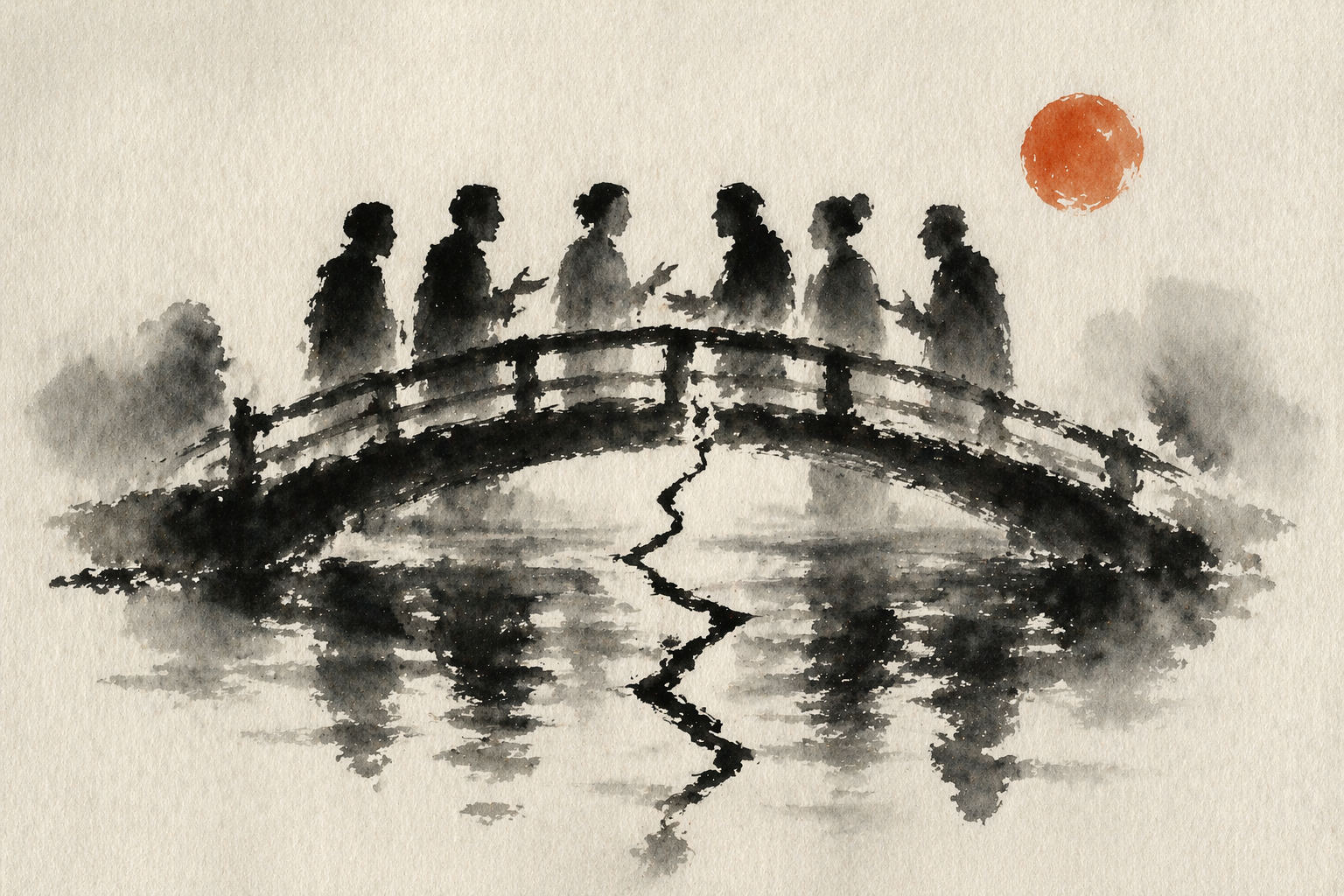
From a distance, the scene appears unified. The figures stand together, gestures aligned, voices seemingly shared. There is no visible conflict, no disruption in the surface of the moment.
But beneath that surface, something is fractured.
The reflection reveals what is not immediately seen: that agreement in language does not always mean alignment in understanding. People may use the same words, reach similar conclusions, or signal consensus, while carrying fundamentally different meanings beneath them.
This is one of the quieter risks in dialogue. Not open disagreement, but the illusion that understanding has been reached when it has only been approximated.
Carrying freedom forward with care requires more than agreement. It requires the patience to remain in the conversation long enough to discover where meaning diverges, even when everything on the surface appears to hold.
Tatemae (建前) vs. Honne (本音)
There is a Japanese concept, tatemae and honne, which describes the distinction between what is expressed outwardly and what is held inwardly. Harmony may be maintained on the surface, while deeper truths remain unspoken.
What You Can Do Next
Ways to carry this conversation forward in everyday life
The insights from this conversation are not meant to stay in the room. They become meaningful when they shape how we move, listen, and respond in the spaces we return to.
The practices below are simple by design. They are not meant to resolve tension, but to help you remain present within it, where understanding has the chance to deepen and take root.
Return to one question, not many
Choose a single question that stayed with you. Revisit it with someone you trust, or sit with it longer than feels natural. Notice how your response evolves over time.
Speak from experience, not position
When you share, ground what you say in something you have lived or observed directly. This creates space for others to do the same, and shifts the conversation from debate to understanding.
Stay in the tension
When disagreement or discomfort arises, resist the urge to resolve it quickly. Instead, remain present. Listen more carefully. Notice what is being revealed beneath the surface.
Examine one assumption
Identify a belief or assumption you hold about a group, issue, or perspective. Ask where it came from, and whether your experience fully supports it.
Make one small, visible move
Choose a single action that reflects care for others. Keep it simple, specific, and repeatable. What you do next matters more than what you agree on.
Protect what is worth carrying forward
Pay attention to what felt meaningful in this conversation—trust, curiosity, openness, restraint. These do not sustain themselves. They require ongoing care.
These practices are not exhaustive. They are starting points. The work of carrying freedom forward does not happen all at once, but through small, consistent choices that shape how we live with one another.
Closing Analysis & Invitation
If this conversation is taken seriously, it asks something more than agreement or affirmation. It asks each of us to consider how we live within a set of ideals that are both deeply meaningful and, at times, unevenly experienced. The language of freedom, equality, and responsibility carries weight not because it is settled, but because it continues to shape how we understand ourselves and one another. What emerged here is not a final answer, but an ongoing question about how those ideals are lived out in real relationships, communities, and decisions.
There is a natural pull to resolve differences quickly; to decide what is right, who is right, or where the boundaries should be drawn. Yet the conversation suggests another path: one where people remain present to complexity without rushing to simplify it. This does not require abandoning conviction, but it does invite a willingness to listen more closely, to examine assumptions, and to recognize that others may be working from equally sincere but different foundations.
The invitation, then, is not to reach consensus but to continue the work with intention. What might it look like to carry both freedom and responsibility into the next conversation, the next relationship, or the next decision you face? What would change if we approached one another not as problems to solve, but as people still working through what it means to live well together?
So the question remains:
What does it look like [for you] to carry freedom forward with care, in a way that honors both what you believe and the people you share it with?
Blind Spot
Analysis
Every conversation reveals something, and leaves something unseen.
What might we be missing?
Although participants demonstrated a willingness to engage tension, reflect on their own perspectives, and consider the responsibility of carrying freedom forward, there are still areas where the conversation may not have fully reached.
Blind Spots for the
Community to Consider
Agreement May Have Replaced Deeper Understanding
In several moments, groups reached alignment quickly. While this created a sense of connection, it may have limited the opportunity to explore where meaning actually diverges. Agreement can feel like progress, but it can also mask important differences that remain unexamined.
Tension Was Named, but Not Fully Lived
The group demonstrated comfort in identifying tensions, such as differences in belief, experience, and perspective. However, naming tension is not the same as staying within it. The deeper work is not just recognizing these dynamics, but remaining present when they become personal or difficult.
The purpose of identifying blind spots is not to diminish what occurred, but to extend it.
Every conversation has edges. Recognizing those edges is what allows the work to continue with greater clarity, humility, and care.
Self-Awareness Emerged, but May Not Yet Be Tested
Participants showed a clear willingness to recognize bias and examine personal assumptions. What remains uncertain is how that awareness holds up outside the structured environment of the conversation, especially in moments of real tension, disagreement, or consequence.
Responsibility Was Identified, but Not Yet Defined in Practice
Participants spoke about responsibility, both personal and collective. What remains less clear is how that responsibility will take shape in daily life. Without translation into consistent action, even meaningful insight can remain abstract.
Some Perspectives May Not Have Been Fully Represented
As with any conversation, what is present is shaped by who is in the room. There may be experiences, viewpoints, or tensions that were not fully expressed or explored, particularly those that are more difficult to voice or less widely shared.
As you reflect on this experience, consider:
What perspective, experience, or tension might not have been fully explored, and what would it take to bring it into the conversation?
New insights? Please share.
As you reflect on the depth and range of what unfolded in your session, we invite you to notice what may still be working on you since the gathering itself. Facilitating a space like this often reveals its meaning gradually—through moments that return later, tensions that linger, or questions that did not yet have language in the room.
If new insights have surfaced, whether about how people showed up, where the conversation opened or narrowed, or what felt most alive or most fragile, we’d welcome hearing them. This might include an unexpected realization, a shift in perspective, or a deeper understanding of what this community may be ready for next.
There is no expectation of answers—only an invitation to share what continues to surface as you sit with the experience. We’re listening.
