

Harlem

Interfaith Dialogue Event
JANUARY 2026
COMMUNITY SESSION
Letter to Mission New York & East Harlem Community Partnership
January 2026
Dear Mission New York and East Harlem Community Partnership,
Thank you for convening the Liberty and Belonging dialogue in Harlem with care and intention. The gathering reflected a community willing to engage difficult questions about dignity, belonging, freedom, and responsibility with seriousness and patience.
As you explore the material on this page, you will encounter a synthesis of the dialogue, key themes and discoveries, reflections on blind spots, and the visual symbols that emerged from shared conversation. Together, these elements offer an account of how participants engaged foundational civic ideals alongside the lived realities that continue to shape who is able to belong, breathe, and participate with dignity today. Immigration and the meaning of welcome emerged not as abstract ideals, but as lived experiences shaped by history, power, fear, and contribution.
What You Modeled
Throughout the dialogue, participants demonstrated a capacity to remain present with tension. They listened across difference, spoke from personal and communal experience, and resisted simplifying complex histories into a single narrative. Care, humility, and restraint were evident, alongside a willingness to name harm and exclusion without withdrawing from relationship. This way of showing up shaped the tone of the gathering and made deeper engagement possible.
What You Discovered
As the conversation unfolded, several shared insights came into focus. Civic ideals and symbols were experienced as unfinished rather than resolved, carrying both aspiration and harm. Belonging was understood as something that cannot be achieved through sameness or goodwill alone, but must account for difference, power, and lived experience. Participants also named curiosity as essential and costly, requiring time, emotional labor, and a willingness to question inherited assumptions. Small, relational actions were recognized as meaningful, not because they replace justice, but because they help build the trust and presence that make broader change possible.
What You Carry Forward
What emerged most clearly was a readiness to continue this work beyond a single gathering. Participants expressed the need for spaces that can hold unfinished questions over time, where listening remains active and responsibility is shared. This positions Mission New York as a steward of continuity, able to offer containers where dialogue becomes an ongoing civic and interfaith practice rather than a one-time event. The work ahead is not about arriving at agreement, but about sustaining presence, accountability, and relationship as the community continues to learn how to live together with dignity.
The reflections and materials that follow are offered in that spirit. They are meant to be returned to, engaged slowly, and held as a living record of what surfaced in Harlem and what the community may be ready to practice next.
With appreciation,
The Freedom Fast Team
Mission New York, Harlem
Interfaith Dialogue Event
A Multarity Synthesis
Our conversation unfolded as a careful holding of tensions rather than a march toward agreement. Foundational ideals of liberty, equality, and belonging were placed side by side with the lived histories of exclusion, displacement, and harm that complicate those ideals. Participants spoke from personal and communal experience, testing whether civic symbols and founding language can still carry moral weight when their origins and applications have been uneven and, at times, violent. What emerged was not a rejection of shared ideals, but a refusal to treat them as settled or self-evident. The group lingered in the discomfort between aspiration and reality, asking whether inherited narratives can be re-authored without being erased, and whether hope can survive honest confrontation with history.
Across faith traditions and life paths, a shared concern surfaced around dignity, safety, and the human need to belong. Stories of migration, racialized exclusion, policing, education, and work revealed overlapping vulnerabilities alongside important distinctions. Participants resisted flattening these experiences into a single story, recognizing that sameness can obscure injustice just as easily as division can. Faith appeared both as a source of trust and moral grounding and as a tradition that has, at times, justified harm. Rather than resolving this contradiction, the conversation treated it as a live question: how spiritual communities can function as places of refuge, accountability, and action without repeating the injuries of the past.
Throughout the exchange, curiosity itself became a theme—named as something essential yet costly. To truly see another person, to listen without rushing to judgment or certainty, requires time, emotional labor, and a willingness to question one’s own assumptions. Participants noted that community care and personal responsibility matter deeply, but they cannot replace the need for systems to change or for power to be held accountable. Small, relational acts were valued not as a substitute for justice, but as seeds of trust and presence that make broader change possible. The conversation closed without resolution, but with a shared recognition that progress lives in the space between certainty and doubt, where people remain willing to breathe, question, and stay with one another even when the answers are not yet clear.
Invitation for Further Exploration
Rather than reading this synthesis as something to agree or disagree with, we invite you to sit with it as a mirror. The tensions, symbols, and multarities surfaced in Harlem are not abstract—they touch lived experience, history, belief, and responsibility. The questions below are offered not to move you toward a position, but to help you notice where your own assumptions, reactions, and hopes come into focus.
Where did I feel resonance—and where did I feel resistance—as I read this synthesis?
Which tension do I instinctively try to resolve instead of hold, and why?
What parts of my own story shape how I interpret ideas like dignity, belonging, or freedom?
Where might I be substituting clarity or conviction for curiosity?
What truths am I comfortable naming—and which ones do I tend to avoid or soften?
How do I respond when ideals collide with lived reality in my own community or relationships?
What might I need to set down—certainty, defensiveness, inherited narratives—to stay open to deeper understanding?
If this work is unfinished, what is one small way I am already participating in shaping what comes next?
Key Themes:
What unfolded across the room and among groups was not a single thread of dialogue, but a constellation of voices moving in parallel—sometimes intersecting, sometimes diverging, often circling the same questions from different angles. In small groups and shared moments, people spoke from lived experience, faith, memory, and concern for what comes next. Rather than converging on answers, these exchanges revealed patterns of attention: where people slowed down, where tension persisted, and where curiosity opened new ground. The themes below capture those shared points of focus—places where meaning was being tested, stretched, and held without being forced into agreement.
Unfinished Ideals and the Weight of History
A central theme was the tension between civic ideals and the histories that complicate them. Concepts like liberty, equality, and belonging were not dismissed, but they were no longer treated as settled truths. Instead, they were examined as aspirations shaped by exclusion, selective application, and inherited power. The conversation revealed a shared curiosity about whether these ideals can still guide the future if they are held honestly, without glossing over the harm that accompanied their formation. What emerged was an understanding that meaning is not lost by confronting history; it is sharpened by it.
Belonging Without Erasure
Participants repeatedly returned to the challenge of honoring difference while resisting division. Experiences of migration, racial identity, faith, and community life surfaced as distinct rather than interchangeable, yet deeply interconnected. There was a clear refusal to collapse these stories into a single narrative of struggle or success. Instead, the group explored how belonging can exist without sameness, and how inclusion that ignores difference can quietly reproduce injustice. The shared discovery was that dignity grows when distinctions are held with care rather than competition.
Care, Accountability, and the Limits of Goodwill
Another theme centered on the relationship between relational care and structural responsibility. Acts of presence, mentorship, and community support were recognized as powerful and necessary, especially where systems fail or move slowly. At the same time, there was a strong awareness that goodwill alone cannot repair harm created by institutions, policies, or violence. The conversation held these truths together, resisting the temptation to substitute kindness for justice or abstraction for action. This tension highlighted an emerging insight: meaningful change requires both human connection and sustained accountability.
The Cost and Promise of Curiosity
Curiosity itself became a subject of reflection. Listening across difference was described not as a neutral act, but as one that carries real social, emotional, and sometimes personal cost. To remain open requires giving up certainty, comfort, and familiar narratives. Yet participants also named the return on that investment: deeper trust, shared humanity, and the possibility of imagining futures not bound by inherited assumptions. The conversation suggested that progress does not come from resolution, but from the willingness to stay present in uncertainty, to keep asking questions, and to choose relationship even when clarity is incomplete.
Surprising Discoveries:
What emerged most clearly were not conclusions people arrived with, but insights that surfaced only because the space allowed tension, uncertainty, and contradiction to remain intact. As stories overlapped and assumptions were gently tested, several unexpected realizations came into view—discoveries that challenged easy narratives and revealed deeper patterns beneath the surface of the dialogue. These moments did not resolve the questions at hand; instead, they reframed them in ways that felt both unsettling and clarifying.
Symbols Still Breathe, Even When Their History Is Broken
One surprising discovery was that civic symbols many assumed were either empty or irredeemable still carried emotional and moral force. Even when participants named the violence, exclusion, and erasure embedded in those symbols, they did not simply discard them. Instead, language like “breathing,” “exhaling,” and “safety” reappeared, suggesting that symbols can remain alive as containers of human longing even when their origins are compromised. The discovery was not that symbols are innocent, but that they continue to matter precisely because people are still trying to survive inside their shadow.
Curiosity Carries a Real Cost
Curiosity was widely praised, but what surprised many was the recognition that curiosity is not free. Listening across difference requires giving up certainty, comfort, and sometimes social standing. It asks people to risk misunderstanding, to sit with discomfort, and to question inherited beliefs. This reframed curiosity from a virtue into a form of labor—one that demands endurance and choice. The discovery was that avoidance is often less about apathy and more about the high cost of staying open.
Care Is Not the Opposite of Accountability
Another unexpected insight was how consistently people refused the false choice between compassion and justice. Rather than treating community care as a softer alternative to structural change, participants recognized that care without accountability can become a way of managing harm rather than confronting it. At the same time, calls for accountability that lacked relational grounding felt hollow. The discovery here was that care and accountability are not competing values—they fail when separated and gain force only when held together.
Small Acts Shape Systems More Than Expected
A final discovery emerged around scale. While the issues discussed were systemic and large, participants repeatedly returned to small, relational actions—being noticed, being asked a question, being treated as capable—as moments that altered life trajectories. These were not framed as substitutes for systemic change, but as leverage points within it. The insight was that systems often shift not through grand gestures, but through repeated, disciplined acts of presence that slowly reshape trust, expectation, and possibility.
Not Knowing Together Created More Trust Than Agreement
A surprising discovery was that trust deepened not when people aligned, but when they openly admitted uncertainty. Participants were most connected in moments where no one rushed to resolve tension or claim clarity—where questions were left open and complexity was allowed to stand. This shared willingness to remain unfinished created a sense of mutual respect that agreement alone could not produce. The insight was that coherence does not require consensus; it can emerge from the collective act of staying present with what remains unclear.
How These Insights Can Guide the Community’s Next Step
Taken together, these insights suggest a shift away from fixing problems toward practicing presence. The conversations revealed that some of the most meaningful work does not begin with programs, statements, or solutions, but with disciplined attention to how people show up for one another. When curiosity is treated as a commitment rather than a preference, and listening as an intentional act rather than a courtesy, communities create conditions where trust and dignity can slowly take root. This points toward a form of work that is quiet, relational, and repeatable—small actions carried consistently, rather than grand gestures aimed at immediate resolution.
The insights also highlight that meaningful change often begins at the level of the individual, but does not end there. When one person feels seen, taken seriously, or invited into responsibility, the effects ripple outward—into families, institutions, and systems. Rather than waiting for alignment at the top, the community’s leverage may lie in cultivating shared practices that reinforce belonging, accountability, and care in everyday settings. These practices do not replace structural change, but they create the human groundwork that makes such change possible and sustainable.
Together, these discoveries invite a shared reflection the community might continue to hold: What is the deepest work we are being asked to do here, together, in this moment? The insights do not prescribe an answer. Instead, they offer a model—one where progress emerges through attention, patience, and collective willingness to stay with difficult questions long enough for new possibilities to form.
Throughout the Liberty and Belonging event, DIGNITY emerged as a central theme among each of the table groups. The following section outlines the paradoxes/tensions that emerged within the concept of dignity during this session.
THE MULTARITIES OF
Shared Human Dignity
in an Unfinished World
At the center of these multarities is a shared recognition that dignity is both inherent and fragile. The gathering did not treat dignity as an abstract principle or a solved problem, but as something continuously negotiated—shaped by history, lived experience, faith, power, and proximity. What held these tensions together was a collective willingness to remain present to what is unfinished: the gap between who we say we are, who we have been, and who we are still trying to become together.
What does it actually mean to belong (and to be able to live, breathe, and participate with dignity) in society, today?
Holding Multiple Truths at Once
Another way to understand what unfolded in these gatherings is to see the conversation not as a search for the “right” position, but as an exercise in holding necessary tensions without forcing them into resolution. Each polarity that surfaced—between ideals and history, care and accountability, faith and harm, urgency and patience—represents truths that pull in different directions and yet remain inseparable. When one side is chosen at the expense of the other, understanding narrows and the work becomes distorted.
The space between these poles is where something more honest begins to form. It is where people can acknowledge harm without abandoning hope, honor difference without dissolving belonging, and act with care without letting systems escape responsibility. This middle ground is not compromise or neutrality; it is synthesis. It is where meaning deepens, where design becomes wiser, and where practice becomes more resilient because it is rooted in reality rather than ideology.
By learning to stay with these tensions—rather than rushing to settle them—we strengthen our collective capacity to think clearly and act with integrity. Managing multiple truths at once allows this community to move forward without denying pain, erasing history, or oversimplifying complexity. In doing so, the work shifts from proving a point to becoming a practice: one that invites patience, courage, and shared responsibility as the foundation for what comes next.
As you explore these visual symbols of the Harlem session below, where do you recognize your own thoughts or those of others within its narrative?
What symbols within the artwork speak to you, and what stories do you think they're trying to tell?
In what ways do the visual symbols challenge or expand your current perspectives on belonging?
How do the contradictions and paradoxes illustrated in the art resonate with your understanding or experience with the conversations around liberty and belonging?
A CLOSER LOOK AT SYMBOLOGY
Neither Inside Nor Outside
Belonging is rarely a clean yes or no. It lives in the uneasy space where invitation and refusal overlap, shaped by history, power, and the unspoken rules that determine who is allowed to cross and at what cost.
Across the conversations, this in-between territory surfaced repeatedly—the place where welcome is offered, yet unevenly felt, and where exclusion operates quietly, often without being acknowledged as such.
Light appearing on both sides unsettles the instinct to assign dignity to only one location. It disrupts the idea that justice exists solely within institutions or entirely beyond them, and instead raises a harder question: whether belonging is something conferred by authority or negotiated through presence, persistence, and care.
What lingers is not simply who is permitted to enter, but who decides where the threshold rests, how permeable it becomes, and what is required of those who stand waiting.
What We Breathe Was Here Before Us
The quiet relationship between survival and inheritance. Breath is often experienced as immediate and personal, yet it is shaped by histories, systems, and conditions that predate any one life. What we breathe carries memory—of choices made long ago, of structures built and broken, of care and harm passed forward. At the same time, each breath is an act of presence, a refusal to disappear, and a signal of hope. The image asks us to hold both truths at once: that life is sustained by what came before, and that the act of breathing itself is a continuous invitation to responsibility, repair, and renewal.
Repair Without Forgetting
This image invites contemplation of repair that does not pretend harm never occurred. Wholeness here is not defined by smoothness or perfection, but by the courage to remain intact while acknowledging rupture. The visible thread suggests that healing can be deliberate, patient, and accountable—an ongoing act rather than a final state. Instead of hiding what was broken, the repair becomes part of the form itself, asking whether honesty might be a deeper kind of unity than seamlessness, and whether shared humanity is strengthened not by erasing damage, but by choosing to tend it together.
Passion Under Care

What’s being held here is not heat, but responsibility. Across the conversations, urgency surfaced again and again—born from injustice, grief, memory, and the need to act. Yet alongside that urgency was an equally strong awareness that uncontained conviction can fracture trust, harden positions, and silence the very voices it seeks to defend. The tension was not between caring and acting, but between acting too quickly and acting well. This metaphor points toward a kind of moral discipline: the work of staying present with intensity without letting it become destructive, performative, or coercive.
The deeper question this image raises is not whether conviction is justified, but how it is carried in shared space. Throughout the Harlem gatherings, participants wrestled with how to honor deeply held truths while remaining in relationship with those who carry different histories, wounds, and beliefs. The work, as it emerged, was not about dampening passion or neutralizing difference—it was about learning how to hold power in a way that sustains dialogue rather than ends it. What’s at stake is whether collective change can be fueled by moral clarity without sacrificing patience, humility, and care for one another along the way.
Custodians of What Was Left Behind

Across the Harlem conversations, history was not treated as a distant backdrop but as an active presence—something received rather than chosen, heavy with consequence and incomplete instruction. The group repeatedly returned to the reality that many of the systems, documents, and symbols shaping daily life were inherited without consent and without clarity about how they were meant to evolve. This tension surfaced in questions of responsibility: how to honor what carried genuine intention while refusing what caused harm, and how to discern the difference without a clear guide.
The metaphor gestures toward a shared dilemma: when no one left a set of instructions, neutrality becomes impossible. Doing nothing is itself a decision, as is preservation, revision, or refusal. What emerged was not a demand for erasure nor blind loyalty, but a quieter, harder reckoning—acknowledging that stewardship requires judgment. The unresolved question left hanging is not whether the inheritance is flawed, but whether we are willing to take responsibility for shaping what comes next, knowing that any choice will reveal as much about our values as the legacy we were given.
Harmony Without a Baton
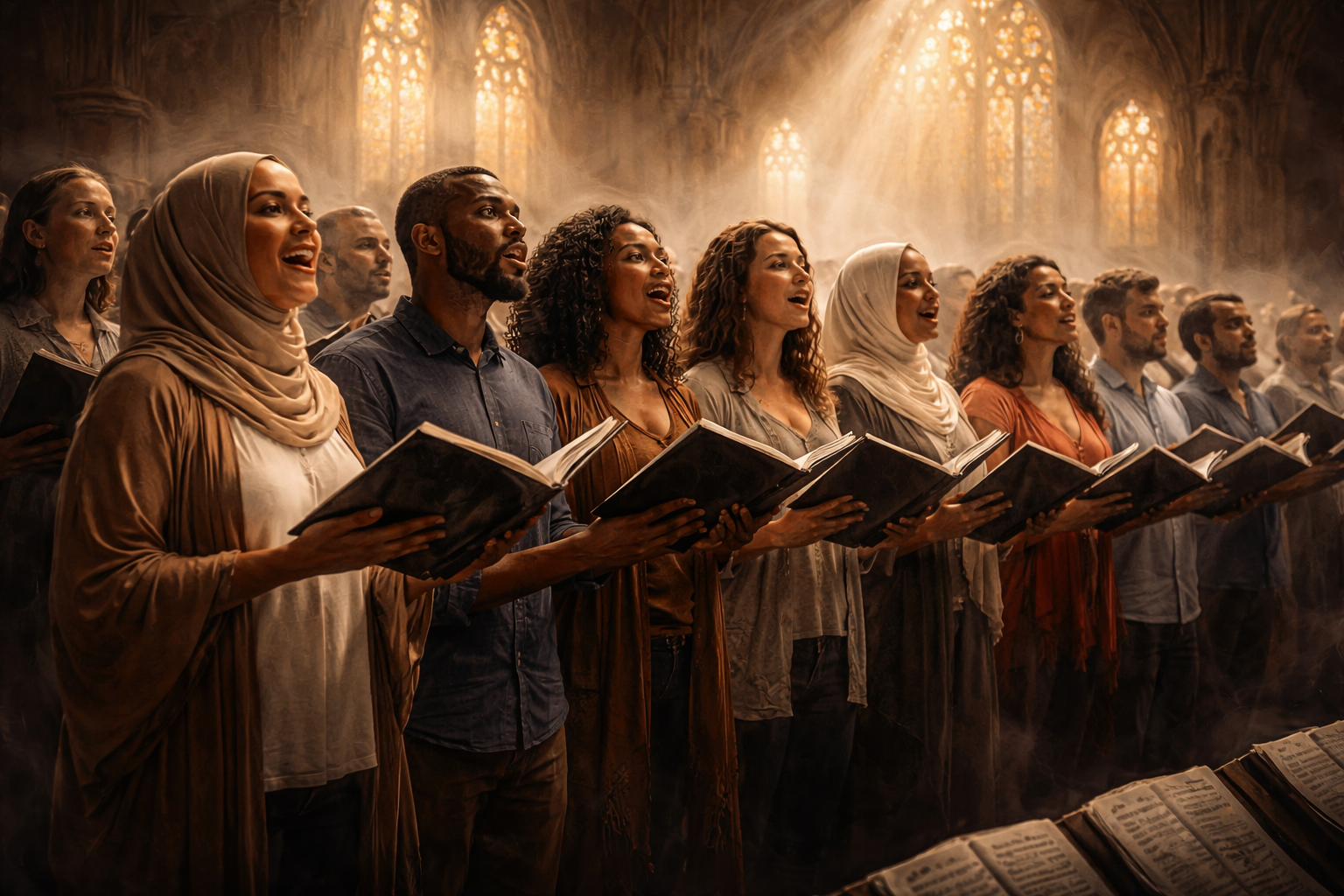
The tension between coordination and autonomy. Voices in the room expressed a desire for collective movement without surrendering individual truth or authority. This metaphor explores whether coherence can emerge without control—and whether harmony requires leadership, or simply deep listening and mutual attunement.
What surfaced repeatedly across the Harlem conversations was a quiet resistance to being directed, paired with an equally strong desire to move together. Participants did not reject coordination, nor were they advocating for fragmentation. Instead, they were probing a more demanding question: whether coherence can arise without hierarchy, and whether leadership must always announce itself to be real. The metaphor holds the tension between shared movement and individual agency—between the fear of domination and the fear of disarray.
Rather than collapsing into ideology or competing claims of authority, the group largely sustained this tension through attentiveness. What allowed the dialogue to remain intact was not agreement, but a collective willingness to listen closely—to adjust pace, tone, and volume in response to one another. The image invites reflection on a deeper form of governance: one where responsibility is distributed, trust replaces control, and harmony is not enforced but earned through mutual presence. The lingering question is not who leads, but what kind of listening makes leadership less necessary.
What You Can Do Next
Ways Mission New York and the community can continue the work of Liberty and Belonging
The practices below offer concrete ways to live into the posture described above, translating shared insights into small, repeatable actions within the community. They reflect what participants named as meaningful and possible and can be taken up at a scale that fits existing relationships and programs.
Bring people back together around shared questions
Reconnect participants from the Harlem gathering within the next two to three months. Use one or two of the original dialogue questions and invite reflection on what has stayed with them since the event. Returning to the same questions over time reinforces trust and signals that complexity is welcome.
Create smaller spaces for listening
Host listening circles of six to eight people drawn from different faith and cultural communities. Establish clear agreements around listening without interruption or response. Smaller groups make it easier for people to participate without fear of exposure and help voices that are often cautious or unheard feel more welcome.
Practice pluralism through relationship
Invite participants from different faith traditions, cultures, and life experiences to spend time together around shared questions rather than shared conclusions. Emphasize learning how to live alongside difference with dignity, even when agreement is not possible. Pluralism becomes tangible when people practice staying in relationship across real difference.
Invite paired conversations across difference
Offer participants the option to meet one-on-one with someone from a different background for a single, intentional conversation. Provide two or three prompts focused on lived experience rather than opinion. Encourage simple settings such as a walk, shared meal, or coffee to support presence and ease.
Ground dialogue in local lived experience
Anchor future gatherings in concrete realities named by the community, such as schooling, migration, housing, policing, or work. Invite participants to speak from personal experience rather than from positions or debates. Keeping the focus local helps conversations remain connected to daily life in the neighborhood.
Expand the symbols that frame the conversation
Participants shared that the Statue of Liberty and the Declaration of Independence do not fully reflect their experience of belonging. Future gatherings can widen the symbolic field by introducing community-generated symbols from the Harlem dialogue, along with local histories, faith-based texts, poetry, music, artwork, or stories identified by participants as meaningful. Multiple symbolic entry points create new ways into the conversation and allow more people to see themselves reflected.
Practice intellectual humility together
Build moments into gatherings where participants are invited to name what they are still learning, where their assumptions have been challenged, or where certainty feels incomplete. Treat not knowing as a shared condition rather than a personal shortcoming. Intellectual humility strengthens dialogue by keeping curiosity active and defensiveness low.
Make power and responsibility visible
Include a question in future gatherings that asks where decisions are made and who is affected by them. Treat this as a shared effort to understand how responsibility is distributed across institutions, systems, and communities. Naming power clearly helps move conversations toward shared responsibility.
Encourage one relational practice to carry forward
At the close of a gathering, invite participants to choose one relational practice to carry for the next thirty days. This might include listening without correcting, checking in on someone who feels isolated, or staying present in a difficult conversation. Small practices, carried consistently, were named as ways trust grows over time.
These practices are offered as ways to keep the work close, grounded, and ongoing. If it is helpful, we are glad to support the design or adaptation of any of these practices as the work continues.
Closing Analysis & Invitation
If this work is to be meaningful, it asks something more of us than agreement or critique. It asks us to recognize that we live in an unfinished world—one shaped by decisions, systems, and exclusions that long predate us, and yet one that continues to change because of what we choose to do now. It is true that many of the promises written into our founding language were never meant for everyone. It is also true that much has changed since then, and continues to change, often because ordinary people refused to accept the limits of what was handed to them. Both truths must be held at the same time.
There is a temptation, especially in moments of disappointment or anger, to see ourselves only as victims of inherited circumstances. That pain is real and deserves to be named. But there is another posture available to us as well—one that recognizes that, like individuals, societies learn unevenly, make mistakes, correct course, and grow. When we know better, we can do better. Seen through that lens, history is not something we are trapped inside of, but something we are responsible for shaping forward. The question is not whether the past was flawed—it was—but whether we are willing to participate in what comes next with honesty, courage, and care.
So the invitation is this: what might we need to set down—certainty, defensiveness, inherited scripts, or the comfort of being right—to make room for deeper work to emerge?
If this path is held with open hands, steady hearts, and a willingness to stay in conversation even when it is difficult, then this unfinished work does not become a burden—it becomes a shared responsibility, returned to season after season, with the quiet conviction that we can, and must, do better together.
So the invitation is this:
What becomes possible if we approach one another not as representatives of positions, but as humans still learning how to live together with dignity?
Blind Spot
Analysis
As we performed a blind spot analysis, we held this question:
What did this conversation make visible, and what might it have allowed us to overlook?
Blind Spots for the
Community to Consider
The Risk of Substituting Insight for Responsibility
Many participants demonstrated high emotional intelligence and moral awareness. A blind spot emerges when that awareness quietly becomes an endpoint. Insight, language, and recognition are powerful, but they can also create a sense of completion that is not yet matched by changed behavior, relationships, or risk. The community may want to ask where understanding must turn into sustained responsibility—especially when no one is watching and no gathering is convened.
The Comfort of Shared Values Masking Real Difference
The group did well holding difference, but another blind spot is how quickly shared language—dignity, humanity, belonging—can smooth over harder disagreements about trade-offs, limits, and loss. Values alignment can feel like unity, even when people would make very different choices under pressure. The community may benefit from exploring where agreement ends and tension truly begins, without seeing that as failure.
Implicit Moral Framing, Even Without Advocacy
Even when not advocating for a position, the design and framing of questions subtly shape what feels “wise,” “mature,” or “evolved” to say. A blind spot for facilitators is assuming neutrality when, in fact, the structure may gently reward certain kinds of responses—measured, reflective, integrative—while making raw anger, refusal, or despair feel out of place. This does not silence voices outright, but it can contour the field.
Assuming Shared Readiness for Multarity
Not everyone enters a space with the same capacity to hold paradox. Some participants are still metabolizing trauma, loss, or threat. A blind spot for facilitators is assuming that everyone is equally resourced to sit with complexity without first needing validation, protection, or solidarity. Multarity is powerful, but it requires pacing, consent, and sometimes sequence.
Blind spots are not mistakes; they are signals of where the next layer of work lives. If the community and facilitators can hold curiosity toward their own shadows with the same generosity they offered one another, future gatherings will not just be safe and thoughtful—they will be increasingly transformative.
Uneven Attention to Power and Consequence
While harm, exclusion, and injustice were named clearly, there was less shared clarity about who holds decision-making power now and how power actually shifts. The conversation occasionally treated harm as ambient rather than situated—something “in the system” without tracing where leverage, accountability, or refusal might realistically live. This can unintentionally diffuse agency, leaving people morally awakened but strategically unsure.
The Pull Toward Abstraction When Pain Is Personal
At moments, deeply personal stories gave way to generalized framing. While abstraction helps people stay in the room, it can also distance the body, grief, or anger that initially motivated the dialogue. A blind spot here is the tendency to intellectualize pain just enough to make it discussable, but not fully encounterable. The question to hold is where abstraction protects connection—and where it protects avoidance.
Blind Spots for Hosts & Facilitators to Consider
Holding Space Without Always Naming the Stakes
The facilitators were skilled at creating psychological safety, but safety can sometimes come at the cost of urgency. There were moments where the gravity of harm—particularly ongoing harm—was softened by the cadence of dialogue. A blind spot here is under-signaling that some tensions are not merely philosophical, but existential, time-bound, and costly in people’s lives right now.
The Absence of Explicit Closure or Continuity
While the invitation to ongoing work was present, the conversation did not always make clear what happens after insight. A blind spot is leaving people with depth but without a next container—where to return, how to stay connected, or how this work continues beyond a single session. Without continuity, even the most meaningful dialogue risks becoming a beautiful moment rather than a living practice.

New insights? Please share.
As you reflect on the depth and range of what unfolded in Harlem, we invite you to notice what may still be working on you since the gathering itself. Facilitating a space like this often reveals its meaning gradually—through moments that return later, tensions that linger, or questions that did not yet have language in the room.
If new insights have surfaced, whether about how people showed up, where the conversation opened or narrowed, or what felt most alive or most fragile, we’d welcome hearing them. This might include an unexpected realization, a shift in perspective, or a deeper understanding of what this community may be ready for next.
There is no expectation of answers—only an invitation to share what continues to surface as you sit with the experience. We’re listening.
