

Indianapolis
Interfaith Dialogue Event
MARCH 2026
COMMUNITY SESSION

March 31, 2026
Dear Colleagues:
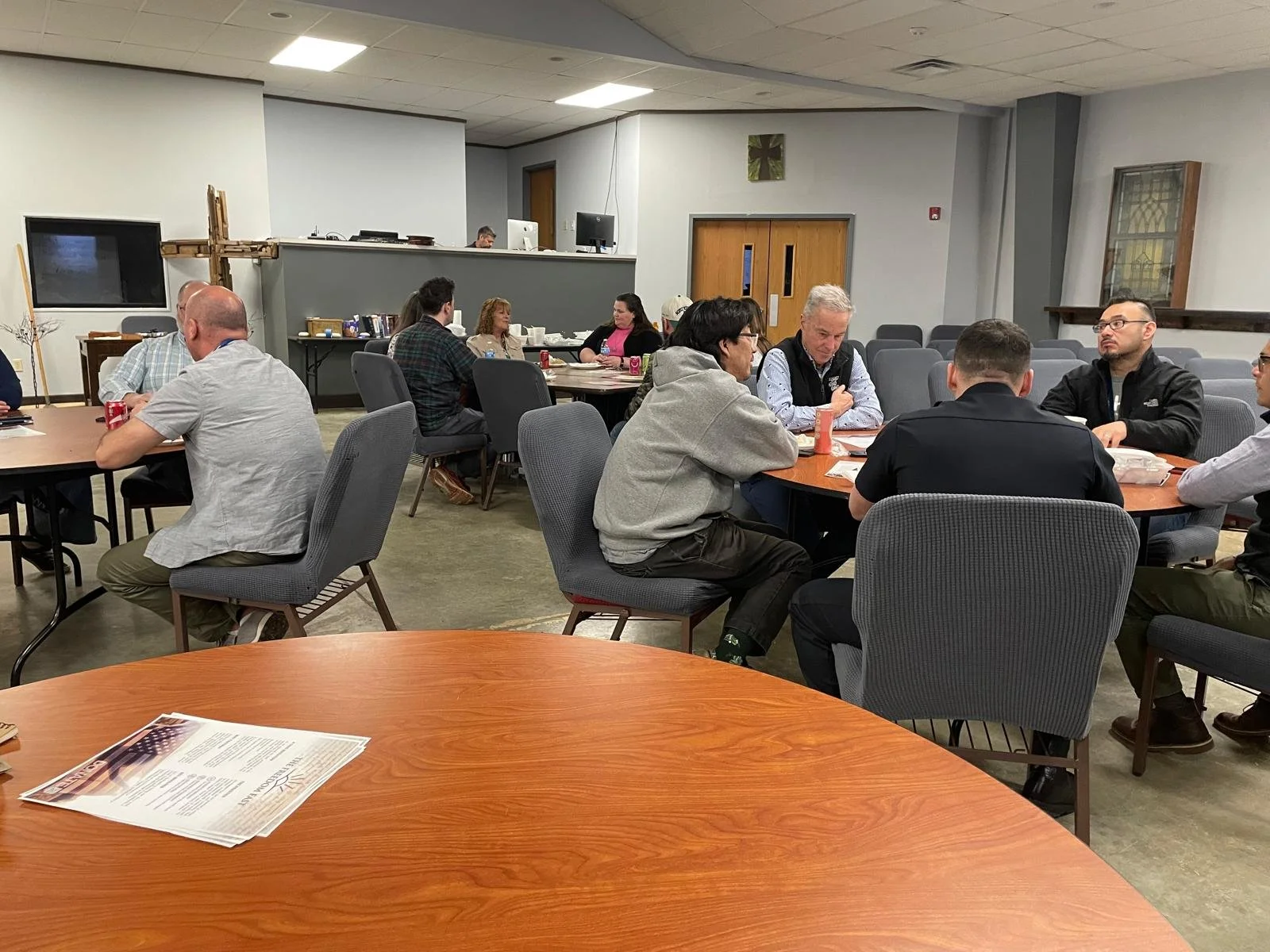
I want to express my deep appreciation for your participation in the Freedom Fast event held for community organizations and clergy on Wednesday, March 25th, at the Shepherd Community. We want to particularly thank Rev. Jay Height of Shepherd and his leadership in putting together the luncheon.
Your discussion around the promise of Life, Liberty, and the Pursuit of Happiness and its relevance for today and the city of Indianapolis was both inspiring and provocative. Your responses were both personal and relevant to the community at-large.
Below, you will find the report prepared by The Multarity Project®, our founding partner in the Freedom Fast, at this link. Please scroll through all the information and images created capturing your conversation. At the end of the report, you will have the opportunity to provide additional feedback and input.
We encourage you to sign up with the Freedom Fast to find a time to pause, relate, and serve as part of a national effort to reflect and to act in response to the 250 th Anniversary of the signing of the Declaration of Independence. This is a sacred pause for civic renewal and affirms a core principle of the Declaration: E Pluribus Unum.
Let us know if you have any questions, and we look forward to working with you in the future.
Seeking peace,
Jim Copple
Co-Founder The Freedom Fast
Indianapolis
Interfaith Dialogue Event
A Multarity Synthesis
What does it mean for a promise to remain unfinished?
The conversation moved between the founding ideals that “all are created equal” and the realities of how equality is experienced today. Some held confidence in the original intent, while others pointed to the distance between principle and practice. Beneath it was a quiet divide: whether these ideals are already sound, or still being worked out in lived experience.
As the focus shifted to relationships across difference, attention turned inward. Personal values, shaped by faith, upbringing, and experience, became the lens through which others are seen. Some described a gradual widening of perspective, while others wrestled with where openness meets its limit, holding the tension between conviction and connection.
When the conversation reached sacrifice and pause, it became more grounded. Letting go of comfort, certainty, or constant input surfaced alongside the need for stillness and reflection. What emerged was a shared recognition: change begins with attention, what we choose to step back from, and what we allow ourselves to truly hear.
Invitation for Further Exploration
Rather than reading this reflection as something to agree or disagree with, we invite you to sit with it as a mirror. The perspectives shared in this conversation reflect real tensions—between ideals and reality, conviction and openness, certainty and curiosity. These are not abstract ideas; they show up in everyday relationships, decisions, and the way we move through the world. The questions below are offered as a way to continue the work inwardly, not to arrive at answers, but to notice what emerges.
When I think about equality, freedom, or opportunity, what personal experiences most shape my view?
Where do my convictions help me engage others, and where might they create distance?
What kinds of people or perspectives do I find hardest to sit with, and why?
When have I changed my mind or softened my stance through relationship or experience?
What might I need to set aside—certainty, defensiveness, or assumption—to listen more fully?
Where in my life could a more intentional pause create space for reflection or clarity?
If change begins at a personal level, what is one small way I am already participating in that work?
These questions are not meant to resolve tension, but to help you stay with it long enough for something deeper to take shape.
Key Themes:
What emerged in the conversation was not a single shared conclusion, but a set of recurring tensions that participants returned to from different angles. People spoke from personal belief, lived experience, and observation of their communities, often circling the same questions about equality, difference, and responsibility. Rather than resolving these questions, the dialogue revealed where participants were leaning in, where they felt tension, and where they were still working things out. The themes below reflect those shared points of focus.
Ideals vs. Lived Reality
Participants returned repeatedly to the gap between the promises of the Declaration of Independence and how those promises are experienced today. For some, the ideals of equality and liberty remain intact and meaningful when understood in their historical context. For others, those same ideals feel incomplete when viewed through present-day inequities in opportunity, treatment, and access. This created a tension between honoring foundational principles and acknowledging where they are not yet fully realized.
Conviction vs. Relationship
A central theme was how to relate to people with fundamentally different beliefs. Many participants grounded their views in faith or deeply held values, which shaped how they interpret right and wrong. At the same time, there was an expressed desire to remain in a relationship with others across those differences. This raised ongoing questions: How do you stay connected to others without compromising your beliefs? Where does openness end and the boundary begin? The conversation did not resolve this, but it surfaced the complexity of holding both.
Diversity vs. Shared Direction
Participants explored the value of diverse perspectives alongside the challenge of moving forward together. Some saw diversity of thought and experience as a strength that leads to better understanding and growth. Others questioned whether shared progress is possible if people are working toward fundamentally different visions of what is good or right. This revealed a tension between inclusion of many viewpoints and the need for some level of shared direction or common ground.
Action vs. Inner Work
As the conversation turned toward sacrifice and pause, participants shifted from broad ideas to more personal reflection. Some focused on outward action: serving others, contributing to community, or making tangible sacrifices. Others emphasized inner work: rest, listening, stepping back from noise, and examining one’s own habits or assumptions. Together, these perspectives highlighted a tension between doing and being: whether meaningful change begins with external action, internal reflection, or an ongoing interplay between the two.
Surprising Discoveries:
What surfaced in this conversation were not just positions people brought into the room, but realizations that emerged as they listened, reflected, and responded to one another. These insights did not resolve the tensions being discussed; instead, they revealed deeper layers beneath them; places where assumptions were challenged, reframed, or quietly expanded.
Equality Is Interpreted Through Lived Experience, Not Just Principle
While the language of equality was familiar to everyone, what it meant in practice varied widely. Some participants saw it as a foundational truth already embedded in the system, while others experienced it as unevenly applied or still out of reach. The insight here is that shared language does not guarantee shared meaning—people often agree on the words while living very different realities behind them.
Conviction and Curiosity Often Compete for Space
Participants expressed both a desire to hold firm to their beliefs and a recognition of the importance of understanding others. These two impulses did not always coexist easily. In moments where conviction was strongest, curiosity narrowed; where curiosity expanded, certainty sometimes softened. The insight is that staying open requires an ongoing negotiation between holding what you believe and making space for what you do not yet understand.
Openness Can Grow Without Agreement
Several participants described a personal shift over time—from distance or discomfort toward a greater willingness to sit with people who live or believe differently. What was notable is that this shift did not necessarily come with agreement or alignment. The insight is that relationship can deepen even when convictions remain intact, suggesting that connection does not require resolution.
Small Personal Shifts Carry Broader Implications
When the conversation moved toward sacrifice and pause, the most concrete responses were not large, symbolic actions but small, personal adjustment; listening more intentionally, stepping back from constant input, making time for rest, or rethinking daily habits. The insight is that meaningful change is often grounded in these smaller shifts, which quietly influence how people show up in relationships, communities, and decisions over time.
How These Insights Can Guide the Community’s Next Step
Taken together, these insights point toward a shift in emphasis; from trying to resolve differences to learning how to remain present within them. The conversation showed that people bring deeply formed beliefs, experiences, and interpretations into shared spaces, and that progress does not necessarily come from agreement, but from the willingness to stay engaged with what is complex and unresolved. This suggests that the work ahead is less about finding the right answers and more about strengthening the capacity to listen, reflect, and remain in relationship across difference.
The insights also highlight that meaningful movement often begins at a personal level. When individuals become more aware of how their experiences shape their views, when they make small adjustments in how they listen or respond, or when they create space for reflection in their own lives, those shifts influence how they engage others. Over time, these patterns can extend outward into families, communities, and shared spaces, creating conditions where deeper understanding becomes possible.
Together, these discoveries invite an ongoing question for the community to hold: What does it look like to participate in this work not just during a conversation, but in the way we live, relate, and show up afterward? The path forward may not be defined by large, immediate changes, but by consistent, intentional practices that keep people connected to both their convictions and their curiosity as they continue the conversation.
THE MULTARITIES OF
Freedom & Responsibility
The conversation was about how we live out freedom, together, in a world where we don’t agree on truth, belonging, or responsibility. What emerged in the conversation can be understood not as opposing arguments to resolve, but as tensions to hold. These multarities reflect truths that coexist and shape how participants make meaning, relate to one another, and navigate complex questions about identity, belief, and responsibility.
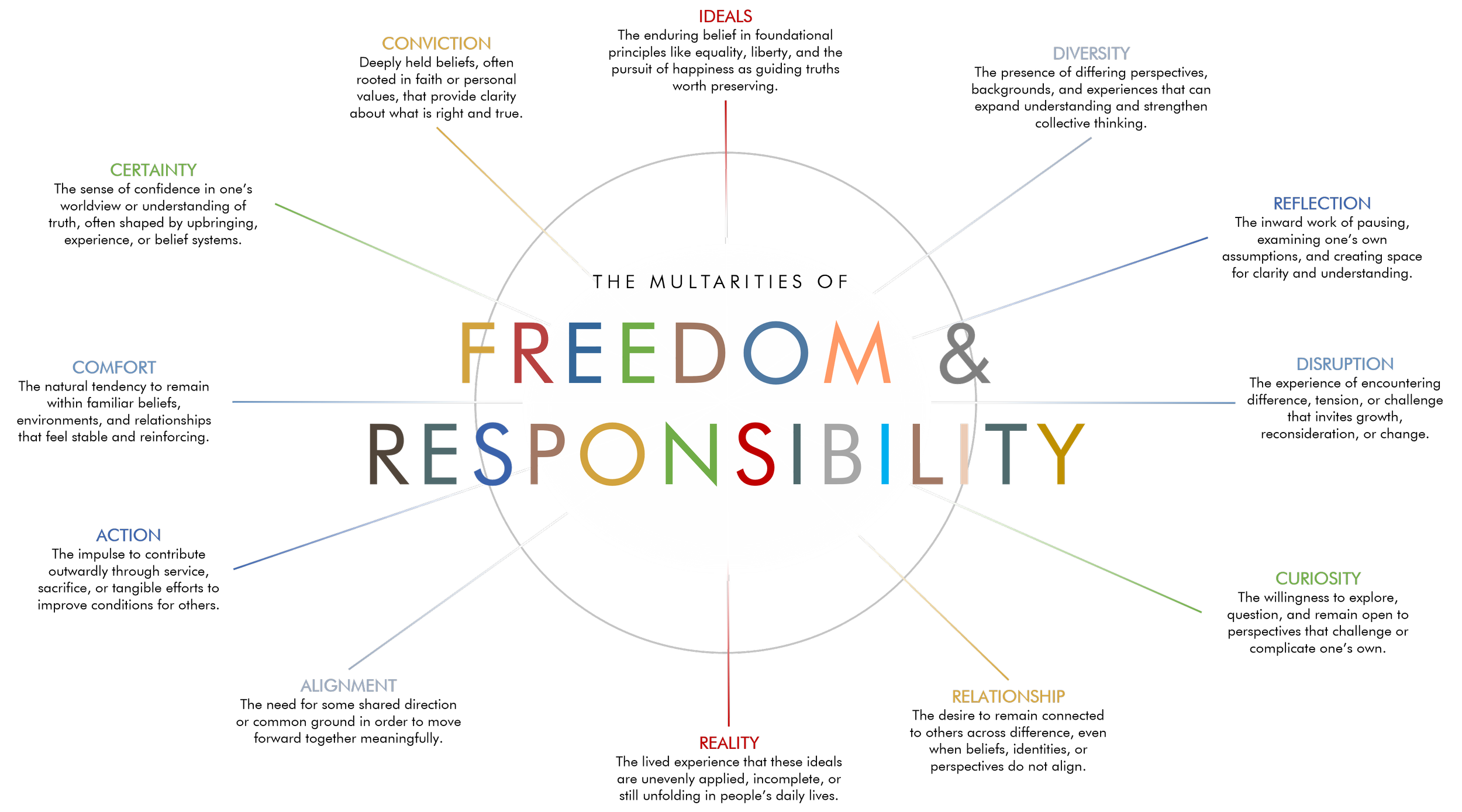
The conversation revealed a series of tensions around how people hold their beliefs while living alongside others who see the world differently. Participants moved between commitment to their values and a desire for connection, between ideals of equality and the realities they experience, and between the comfort of certainty and the challenge of staying open.
At its core, the multarities reflect an ongoing effort to understand how freedom is lived out in relationship, recognizing that it requires both personal responsibility and a willingness to engage across difference.
The central question …
How do we live with difference without losing what we believe is true?
Holding Multiple Truths at Once
At the center of this conversation was an attempt to understand how people navigate their own beliefs while living in a shared world with others who see things differently. The discussion was not about choosing between competing ideas, but about navigating the space where they meet; where personal conviction, shared ideals, and lived realities intersect. Each multarity reflects a different facet of that experience: the pull between what we believe and how we relate, between what is promised and what is practiced, and between individual autonomy and collective life.
These tensions do not cancel each other out; they define the work itself. Freedom, as it was discussed, is not simply the ability to act or believe independently, but something shaped by how we show up with others; how we listen, where we draw boundaries, and what we are willing to examine or set aside. Responsibility, in turn, is not imposed from the outside, but emerges through participation in that shared space. Holding these together allows for a more honest and grounded way forward, one that does not require agreement, but does require presence, reflection, and care in how we move with and toward one another.
By learning to stay with these dynamics—rather than forcing them into simple answers—we strengthen our ability to engage thoughtfully and act with care. Holding multiple truths at once allows individuals and communities to move forward without ignoring differences or oversimplifying complexity. In doing so, the conversation becomes less about resolving disagreement and more about practicing how to live responsibly and meaningfully alongside one another. participation in that shared space. Holding these together allows for a more honest and grounded way forward, one that does not require agreement, but does require presence, reflection, and care in how we move with and toward one another.
As you explore these visual symbols of the Indianapolis session below, where do you recognize your own thoughts or those of others within its narrative?
What symbols within the artwork speak to you, and what stories do you think they're trying to tell?
In what ways do the visual symbols challenge or expand your current perspectives on belonging?
How do the contradictions and paradoxes illustrated in the art resonate with your understanding or experience with the conversations around liberty and belonging?
A CLOSER LOOK AT SYMBOLOGY
The Same Table, Different Maps
What gives this image its weight is not disagreement, but the quiet complexity of people trying to make sense of something together while carrying different understandings of what that “something” is. Each person is engaged, thoughtful, and contributing with sincerity. There is a shared desire to orient, to understand, to move forward. And yet beneath that shared effort is a deeper layer: the recognition that meaning is not fixed, but shaped by experience, belief, and perspective.
The image invites a different kind of awareness, not about choosing the “right path” defined by someone else, but about recognizing the presence of multiple ways of seeing. It suggests that progress may not begin with agreement, but with the willingness to notice where our interpretations differ and to stay in conversation long enough for something more complete to emerge. In that sense, the table becomes less a place of decision and more a place of discovery, where understanding is built, not assumed.
Guided by What We Trust
What stands out in this image is not disagreement, but confidence. Each person is holding something they trust, something they believe is steady, reliable, and worth following. There is no sense of chaos or confusion, only the quiet reality that direction is not universally shared. The deeper implication is that people rarely experience themselves as lost. More often, they feel oriented, guided by conviction, shaped by experience, and grounded in something that feels true.
The question the image invites is not how to correct direction, but how to move forward when direction diverges. If each person is following what they believe is right, what does it take to remain in proximity, to stay in conversation, or to choose a shared path? It suggests that the work is not in forcing alignment, but in recognizing that difference in direction is often rooted in sincerity, and that navigating that difference requires both clarity about where you stand and care for those who stand elsewhere.
The Distance Between Us
What gives this image its meaning is not the gap itself, but the effort on both sides to close it. Each group is building with intention, care, and a sense of purpose. There is no hostility, only commitment. And yet, despite that shared effort, the structures do not meet. The difference is not in desire, but in design. What each side believes is the “right” way to build is shaping the outcome more than the shared goal of connection.
The image raises a quiet but consequential question: what happens when good faith effort is not enough? When people are equally committed to reaching each other, but guided by different assumptions about what the bridge should be, how it should function, or even why it should exist. It suggests that connection is not just about willingness, but about alignment at a deeper level; about recognizing that how we build matters as much as why we build. And sometimes, the work begins not by extending further, but by stepping back to understand what we are building toward in the first place.
A Mirror That Reflects Yourself When You Expect to See Others



What makes this metaphor powerful is how invisible it is while it’s happening. The person believes they are looking outward: observing, evaluating, and understanding others. But what is actually being revealed is inward: their own assumptions, their own formation, their own way of making sense of the world. The shift is subtle but profound. The conversation doesn’t just reveal differences between people; it reveals the lens through which those differences are interpreted.
The deeper implication is that understanding others is never a purely external act. Every judgment, every conclusion, every reaction carries traces of personal history, belief, and experience. The work, then, is not only to listen more carefully to others, but to become aware of what we are bringing into the act of listening itself. In that sense, the mirror is not a barrier to understanding … it is an invitation. To see more clearly, not just what is in front of us, but what is shaping how we see.
Between Signal and Noise

What becomes visible in this frame is that not everything loud is meaningful, and not everything quiet is empty. The distinction is not between noise and silence, but between what carries signal and what distorts it. The dial represents a more precise responsibility: not just reducing volume, but discerning what is worth hearing in the first place.
Signal requires space. It emerges when reaction slows, when certainty softens, when we allow something beyond our immediate impulses to register. Noise, by contrast, fills that space before signal has a chance to form. The risk is not simply overstimulation, but miscalibration, confusing intensity for importance, repetition for truth, and immediacy for relevance.
To live between signal and noise is to practice ongoing discernment. It asks a different question than “What do I think?” or even “What do I believe?” It asks, “What is actually worth attending to?” And that question cannot be answered at full volume.
What You Can Do Next
Ways participants can continue the work of Freedom & Responsibility
The practices below translate the conversation into small, repeatable actions. They are designed to keep the work grounded in lived experience, relationship, and everyday life—where freedom and responsibility are most often expressed.
Return to one question, not many
Choose one question from the conversation and revisit it in a small group or with a trusted person. Stay with it longer than feels natural. Notice how your response changes over time rather than trying to arrive at a final answer.
Speak from experience, not position
In future conversations, anchor what you share in something you have lived or observed directly. This shifts the tone from debate to understanding and makes space for others to do the same.
Have one conversation across difference
Sit down with someone whose background, beliefs, or perspective differs from your own. Keep the focus on understanding their experience rather than comparing viewpoints. A single honest conversation can reshape assumptions more than abstract discussion.
Practice intentional pause
Set aside a small, consistent moment, daily or weekly, to step back from noise, input, or routine. Use that time to reflect, listen, or simply notice what is present in your thoughts and interactions.
Examine one assumption
Identify one belief or assumption you hold about a group, issue, or idea. Ask yourself where it came from and whether your experience fully supports it. Stay curious rather than defensive.
Choose one act of responsibility
Select a simple, concrete action that reflects care for others, within your family, neighborhood, or workplace. Let it be specific and repeatable rather than symbolic or one-time.
Stay in the conversation
Resist the urge to withdraw when disagreement surfaces. Instead, remain present, listen carefully, and allow space for complexity. The work is not in resolving difference quickly, but in learning how to remain engaged within it.
These practices are not meant to be exhaustive or prescriptive. They are starting points—ways to carry the conversation forward through attention, relationship, and small, consistent choices that shape how we live with one another.
Closing Analysis & Invitation
If this conversation is taken seriously, it asks something more than agreement or affirmation. It asks each of us to consider how we live within a set of ideals that are both deeply meaningful and, at times, unevenly experienced. The language of freedom, equality, and responsibility carries weight not because it is settled, but because it continues to shape how we understand ourselves and one another. What emerged here is not a final answer, but an ongoing question about how those ideals are lived out in real relationships, communities, and decisions.
There is a natural pull to resolve differences quickly; to decide what is right, who is right, or where the boundaries should be drawn. Yet the conversation suggests another path: one where people remain present to complexity without rushing to simplify it. This does not require abandoning conviction, but it does invite a willingness to listen more closely, to examine assumptions, and to recognize that others may be working from equally sincere but different foundations.
The invitation, then, is not to reach consensus but to continue the work with intention. What might it look like to carry both freedom and responsibility into the next conversation, the next relationship, or the next decision you face? What would change if we approached one another not as problems to solve, but as people still working through what it means to live well together?
So the question remains:
What does it look like, for you, to live out freedom in a way that also honors your responsibility to others?
So the question remains:
What does it look like—for you—to live out freedom in a way that also honors your responsibility to others?
Blind Spot
Analysis
As we performed a blind spot analysis, we held this question:
What did this conversation make visible, and what might it have allowed us to overlook?
Blind Spots for the
Community to Consider
The Tendency to Speak from Belief Rather Than Experience
Much of the conversation drew from established beliefs, values, and frameworks. While these are important, they can sometimes create distance from lived experience;both one’s own and others’. A potential blind spot is how quickly conversation can move to what we think or believe, rather than what we have directly encountered or wrestled with in our own lives.
The Pull Toward Defining Boundaries Before Fully Exploring Relationships
At moments, the conversation moved toward questions of where connection may no longer be possible or where lines should be drawn. While these are important considerations, a blind spot may be how early those boundaries are considered, sometimes before fully exploring what understanding or relationship might still be possible.
The Framing of Questions Shapes the Direction of Thought
The nature of the questions posed influences how participants respond; whether they speak from abstraction, belief, or experience. A blind spot may be underestimating how much the framing itself guides the type and depth of engagement.
The Absence of Clear Continuity Beyond the Conversation
While the dialogue invited reflection, the path forward may not always be explicit. A blind spot is leaving participants with meaningful thoughts but without a clear sense of how to continue the work in their own contexts or relationships.
By noticing these blind spots, the conversation does not diminish; it becomes more complete. Each one points toward an opportunity: to listen more closely, to question more carefully, and to remain engaged in the ongoing work of understanding what it means to live with both freedom and responsibility.
Blind spots are not mistakes; they are signals of where the next layer of work lives. If the community can hold curiosity toward what may have gone unexamined with the same openness they brought to the conversation, future dialogues can deepen in both clarity and impact.
The Assumption of Shared Meaning Behind Shared Language
Words like freedom, equality, and responsibility were used throughout the discussion, often with a sense of familiarity. However, participants brought different interpretations and experiences to those same terms. A blind spot emerges when shared language is assumed to carry shared meaning, which can mask deeper differences in understanding.
The Influence of Personal Formation on Perception of Others
Participants acknowledged that upbringing, faith, and past experiences shape how they see the world. A continued blind spot is how deeply these formative influences operate, often unnoticed, in shaping assumptions about entire groups or ideas. Recognizing this influence more fully can open space for greater awareness and flexibility.
Blind Spots for Hosts & Facilitators to Consider
Balancing Openness with Depth
Creating a space where everyone feels able to participate is essential. At the same time, openness alone does not always lead to deeper reflection. A blind spot can be assuming that participation naturally leads to insight, without additional structure to guide the conversation beneath the surface.
New insights? Please share.
As you reflect on the depth and range of what unfolded in Harlem, we invite you to notice what may still be working on you since the gathering itself. Facilitating a space like this often reveals its meaning gradually—through moments that return later, tensions that linger, or questions that did not yet have language in the room.
If new insights have surfaced, whether about how people showed up, where the conversation opened or narrowed, or what felt most alive or most fragile, we’d welcome hearing them. This might include an unexpected realization, a shift in perspective, or a deeper understanding of what this community may be ready for next.
There is no expectation of answers—only an invitation to share what continues to surface as you sit with the experience. We’re listening.
